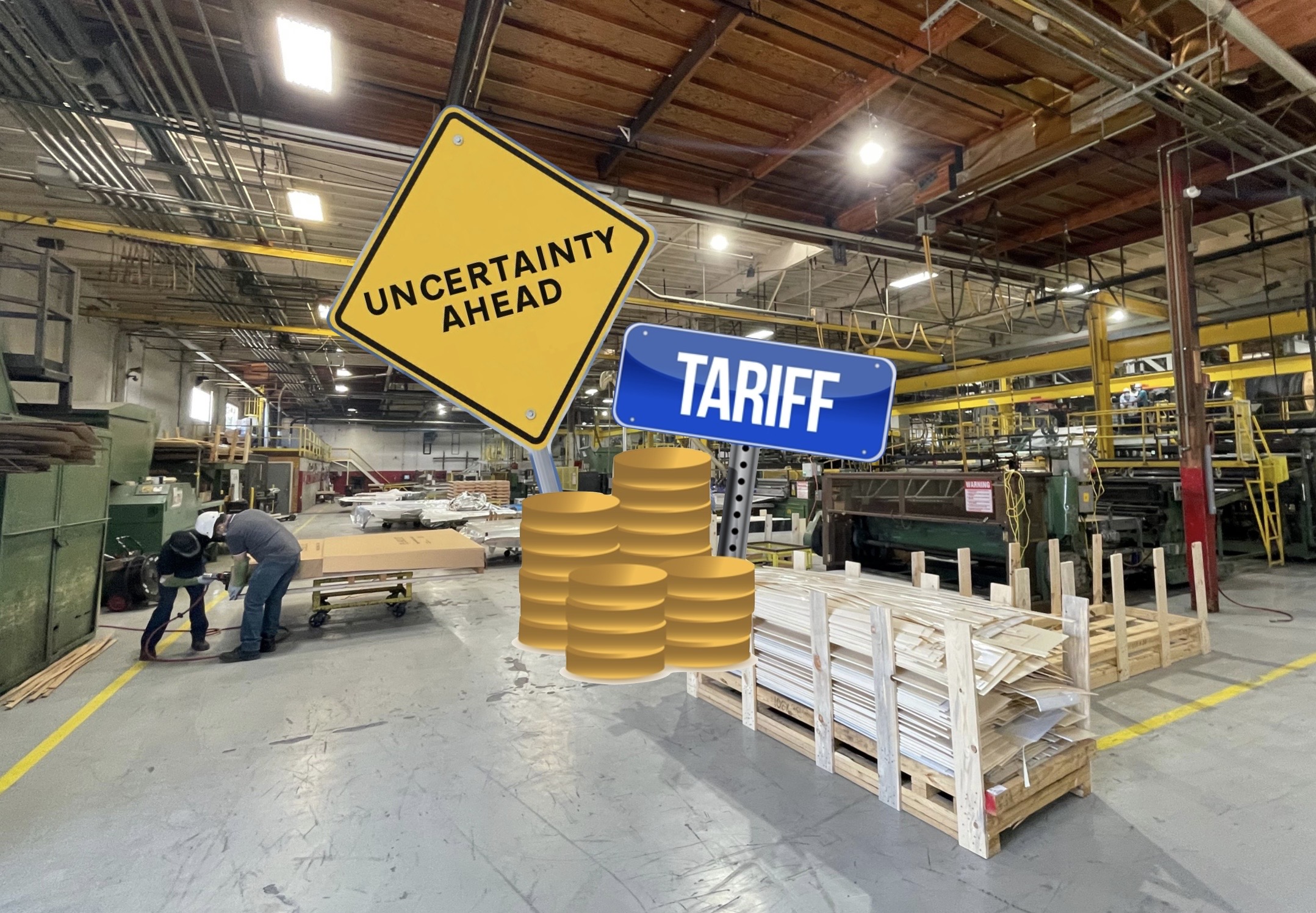
The tariffs – many announced in April 2025 – were ruled unlawful by the Supreme Court in February 2026. However, a review by the Associated Press found that the federal government had already collected more than $130 billion on the tariffs by mid-December and might ultimately be forced to refund $175 billion, according to calculations by the Penn Wharton Budget Model.
Following the Court’s decision, Pres. Trump announced an executive order that would allow him to go around Congress and impose a 10% tax on imports from around the world for up to 150 days. The administration also said it would launch a Section 301 investigation to ban the importing of goods made by forced labor, as well as other potential targets.
The effect of these developments has been to leave businesses struggling to determine their next steps. That is complicated by the fact that the Trump administration has indicated it may choose to ignore the 150-day limit and extend the duration of the new import taxes.
There is also the question of exactly how and when the tariffs already paid by businesses are to be refunded, a matter not addressed by the Supreme Court.
For example, the owner of Allen Engineering Corp., a small Arkansas business that makes road-paving equipment using machines imported from Germany, told the AP that it would need to invest $20 million to manufacture the machines in the U.S. The risk would be even greater considering that a new administration might change the rules again. The owner noted that he had already been forced to cut his workforce significantly and raise his prices, which threatened his future sales.
The AP tallied 50 actions on tariffs taken by President Trump. “The flurry of announcements, reversals, exemptions and legal challenges – as well as Trump’s decision to bypass Congress to impose tariffs – has made it difficult for smaller manufacturing companies to plan,” AP commented.
The Trump administration has defended its policy, arguing that the tariffs would expand the field for American companies and generate enough revenue to slash budget deficits. In January, the President claimed that investment in American factories was up 41%, a record.
However, Census Bureau data show that between the last quarter of 2024 and the third quarter of 2025, spending declined 6.7%, a trend expected to continue in 2026 and 2027, according to a survey of construction economists by the American Institute of Architects (AIA), cited by AP. It attributed earlier increases in construction spending to the provisions of the CHIPS Act and other legislation enacted by Pres. Biden, especially semiconductor manufacturing it encouraged.
High steel tariffs have been especially concerning for the construction industry. They were not affected by the Supreme Court’s decision. AP cited a February report by the Association of Equipment Manufacturers that noted, “U.S. equipment manufacturers, who employ 2.2 million workers and produce the equipment used to build, power, and feed America, face increasing pressure from surging geopolitical tensions, heightened trade uncertainty, the need to restructure global supply chains, as well as a shortage of 42,000 workers.”
The outcome will be vital for the construction industry. “Spending on nonresidential buildings will increase only 1.0% this year and 2.7% next year, according to the AIA’s latest Consensus Construction Forecast. “Spending on manufacturing facilities, which has surged in recent years, is expected to decline 3.9% this year and 0.9% in 2027.”
The AIA attributed a “stalled” construction landscape to three factors: tariffs, immigration policy, and federal government spending. Data centers, however, are predicted to grow by 26%.
Sources: https://www.globest.com/2026/03/19/small-manufacturers-bear-the-brunt-of-tariff-uncertainty/, https://apnews.com/article/trump-tariffs-manufacturing-china-030d58f482ce2505721a3ce86820d1da